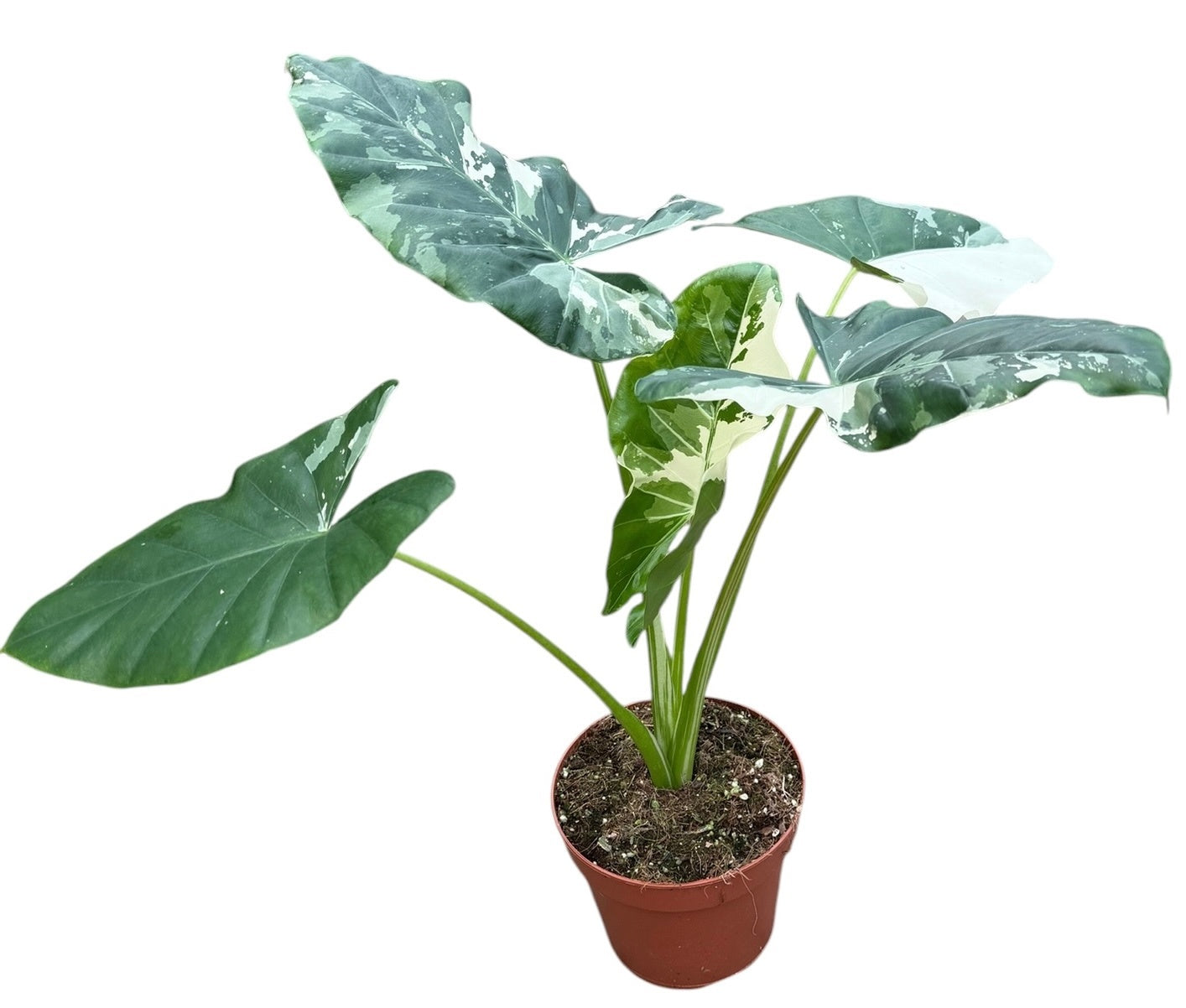
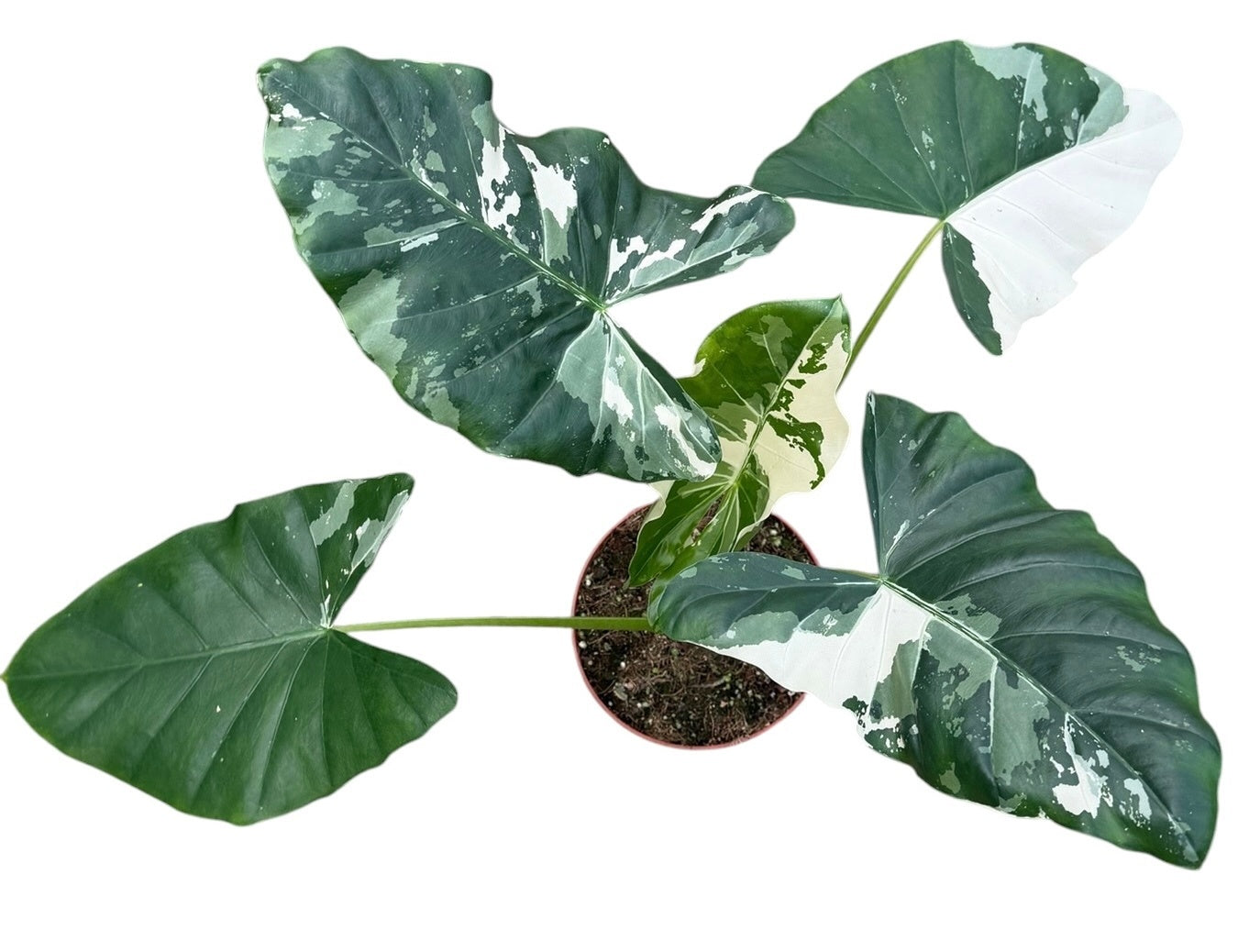
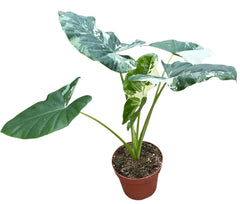
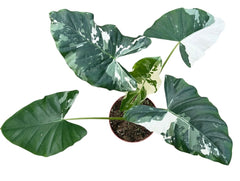
Alocasia macrorrhizos ‘Variegata’, commonly known as the Variegated Giant Taro or Variegated Elephant Ear, is a spectacular tropical plant recognised for its enormous, upright leaves and unpredictable marbled colouring.
Each leaf displays its own combination of rich green, lime, cream and bright white. The variegation may appear as broad sectors, scattered splashes, fine marbling or a combination of several patterns. No two leaves are identical, and the appearance of future growth will naturally vary.
As the plant matures, it can produce increasingly large, arrow-shaped leaves held on tall, sturdy stems. Under suitable indoor conditions, an established plant can become an impressive architectural feature. Its upright growth habit makes it particularly effective as a statement plant in a bright room, conservatory or heated greenhouse.
The pale areas of its leaves contain little or no chlorophyll, making them more delicate than green tissue. Alocasia macrorrhizos ‘Variegata’ therefore requires bright light and stable growing conditions to support its highly variegated foliage.
Please note that plant size, leaf shape and variegation will vary naturally. The pattern of future leaves cannot be guaranteed, and young plants may change considerably as they mature.
Detailed Care Guide
Light
Provide plenty of bright, indirect light. Variegated Alocasias require stronger light than entirely green varieties because their pale leaf sections contain less chlorophyll.
Position the plant close to an east- or west-facing window. Near a south-facing window, filter intense sunlight through a sheer curtain or position the plant slightly farther back.
Gentle morning or late-afternoon sunlight may be tolerated, but strong midday sun can scorch the white and cream sections.
Insufficient light may cause:
- Slow or stalled growth
- Smaller leaves
- Long, weak stems
- Loss of older leaves
- Greener new growth
- Soil remaining wet for too long
A full-spectrum grow light can help maintain steady growth during winter.
Watering
Allow the upper 2–4cm of the growing medium to dry before watering thoroughly. Let excess water drain completely and empty any water collected inside the decorative pot.
Alocasia macrorrhizos ‘Variegata’ prefers lightly and evenly moist soil during active growth, but it is highly susceptible to root and corm rot when kept waterlogged.
Do not follow a rigid watering schedule. The plant’s needs will vary according to light, temperature, humidity, pot size and season.
Water less frequently during autumn and winter, particularly if growth has slowed. Use room-temperature rainwater or filtered water where possible, as hard water may contribute to brown leaf tips.
Humidity
Maintain moderate to high humidity, ideally between 60% and 80%. Good humidity helps new leaves unfurl correctly and can reduce browning on the white portions.
A humidifier is the most reliable way to increase humidity. Heated plant cabinets and conservatories may also provide suitable conditions, provided there is adequate airflow.
Avoid positioning the plant beside radiators, heaters, air-conditioning units or cold draughts. Misting provides only a temporary increase in humidity and may cause spotting if water remains on the leaves.
Temperature
Keep the plant in a warm environment between approximately 18–28°C. Avoid prolonged temperatures below 15°C.
Alocasias are sensitive to cold and sudden temperature changes. Low temperatures can cause drooping, yellow leaves, dark patches and root damage.
Avoid allowing the foliage to touch cold window glass during winter.
Soil
Use an airy, moisture-retentive but free-draining aroid mixture. A suitable blend may contain:
- Houseplant compost or coco coir
- Medium-grade orchid bark
- Perlite or pumice
- Horticultural charcoal
- A small amount of sphagnum moss or worm castings
The mixture should hold some moisture while allowing oxygen to reach the roots. Dense compost used alone can remain wet for too long and increase the risk of rot.
Always use a nursery pot with adequate drainage holes.
Feeding
Feed every two to four weeks during spring and summer with a balanced liquid houseplant fertiliser diluted according to the manufacturer’s instructions.
Alocasia macrorrhizos can be a relatively hungry plant during active growth, particularly when producing large leaves. However, overfeeding can damage the roots and cause brown leaf tips.
Apply fertiliser to damp soil rather than a completely dry growing medium. Reduce or stop feeding during winter if the plant is not actively growing.
Repotting
Repot when the roots have filled the existing container or the plant has become unstable. Spring or early summer is generally the best time to repot.
Choose a container only slightly larger than the current pot. Moving the plant into an oversized container can leave excessive wet soil around the roots.
Large specimens may become top-heavy, so choose a stable pot that will support the foliage without sacrificing drainage. Handle the roots and corm carefully when repotting.
Growth Habit and Mature Size
Alocasia macrorrhizos is naturally a large, upright plant. Its mature size indoors will depend on light, warmth, feeding, root space and general care.
As it develops, the plant can produce increasingly tall stems and much larger leaves. Give it sufficient space and avoid positioning it where the foliage will regularly brush against walls or furniture.
Rotate the pot occasionally to encourage balanced growth. However, do not turn it too frequently while a new leaf is emerging, as abrupt changes in direction can affect its development.
Variegation
Every new leaf will have an individual pattern. Bright, indirect light helps the plant support its variegated growth, but light cannot determine the exact appearance of the next leaf.
White areas contain no chlorophyll and cannot produce energy for the plant. A healthy balance of green and pale tissue is therefore preferable to leaves that are almost entirely white.
Avoid removing healthy green leaves unnecessarily. These leaves provide energy that supports future variegated growth.
If the plant produces several entirely green leaves, inspect the stem for visible variegation before considering pruning. Cutting the plant back is not guaranteed to restore stronger colouring and should only be attempted on a healthy, established specimen.
New Leaves
New Alocasia leaves emerge tightly rolled and gradually unfurl. They may initially appear soft, pale or slightly uneven before hardening and developing their final colour.
Do not manually pull open a developing leaf. Maintain warmth and humidity and allow it to unfurl naturally.
It is normal for an Alocasia to lose an older leaf occasionally while directing energy into new growth. However, repeated leaf loss may indicate inadequate light, root problems or unsuitable watering.
Dormancy
Alocasia macrorrhizos ‘Variegata’ may slow down considerably during autumn and winter. In cooler or darker conditions, it can lose several leaves and may become temporarily dormant.
If growth slows:
- Reduce watering
- Stop or reduce feeding
- Maintain warmth
- Provide the brightest safe indirect light available
- Avoid repotting unless root rot is suspected
As long as the corm remains firm and healthy, new growth may emerge when warmer, brighter conditions return.
Pruning
Remove yellow, damaged or dying leaves using clean, sharp secateurs. Cut the leaf stem close to the base without damaging the main stem or neighbouring growth.
Do not remove a leaf simply because it has minor cosmetic damage. Any remaining green tissue continues to photosynthesise and support the plant.
Wear gloves when pruning because the sap may irritate the skin.
Propagation
Alocasia macrorrhizos ‘Variegata’ is generally propagated by separating offsets or corms from an established plant.
Small corms may be discovered during repotting. These can be placed into lightly moist sphagnum moss, perlite or another suitable propagation medium and kept warm and humid.
Not every offset or corm will necessarily inherit strong variegation. Wait until new leaves develop before assessing its colouring.
This plant cannot be propagated from an individual leaf cutting.
Cleaning the Leaves
Wipe the leaves gently with a soft, damp cloth to remove dust. Support each leaf from underneath while cleaning it to avoid bending or tearing the stem.
Avoid using commercial leaf-shine products, which can leave a residue on the foliage.
Clean leaves improve the plant’s ability to absorb light and make it easier to identify pests before they become established.
Common Problems
Brown variegated sections: Pale tissue naturally browns more readily. Low humidity, inconsistent watering, intense sunlight, hard water and fertiliser salts can accelerate this.
Yellow leaves: An occasional older yellow leaf can be normal. Several yellow leaves may indicate overwatering, poor drainage, cold conditions or root damage.
Drooping leaves: Check the growing medium before watering. Drooping can be caused by dryness, waterlogged roots, low temperature or transplant shock.
Curling leaves: Often associated with low humidity, underwatering, heat stress or pests.
Small new leaves: May indicate insufficient light, inadequate nutrition, damaged roots or a plant that is still establishing.
Black or soft patches: These can be caused by cold damage, prolonged moisture on the foliage or rot.
No active growth: The plant may be dormant, too cold, receiving insufficient light or recovering from root disturbance.
Soft or mushy corm: This indicates rot. Remove damaged tissue and repot any firm, healthy section into fresh, well-draining growing medium.
Pests
Alocasias are particularly susceptible to spider mites. Check regularly for fine webbing, pale speckling and pests on the undersides of the leaves.
Other potential pests include:
- Thrips
- Mealybugs
- Scale insects
- Fungus gnats
Isolate an affected plant immediately and apply an appropriate houseplant pest treatment. Repeated applications may be necessary to interrupt the pest’s lifecycle.
Toxicity
Alocasia macrorrhizos ‘Variegata’ contains insoluble calcium oxalate crystals and is toxic if eaten. Keep it away from children and pets.
Its sap can irritate the skin and eyes, so wear gloves when pruning, propagating or repotting it and wash your hands thoroughly afterwards.