




Fern
"A beautiful plant, makes me happy! Another gem from Plants for all."


At Plants for all Seasons, we stand behind the quality and vitality of every plant we deliver, which is why we proudly offer a Live Delivery Guarantee. This commitment means that we guarantee your plants will arrive at your doorstep in healthy, thriving condition. We understand the importance of receiving your plants in the best possible state, ready to enhance your space from the moment they arrive. With Plants for all Seasons's Live Delivery Guarantee, you can shop with complete peace of mind, knowing that your green investments are protected from our nursery to your doorstep.

Due to the sensitive and breakable nature of our products, it's understandable that damages may occur despite our meticulous packaging methods. If you find that your plant or pot has arrived in a less than satisfactory condition, please reach out to us at hello@plantsforallseasons.co.uk within a month of your delivery date. When contacting us, please provide your order reference, alongside a photo clearly showing the damaged item and its packaging, including the delivery label. We are committed to resolving such issues by offering a refund or a replacement, depending on the availability of the item in question.
We are unable to accept returns that are not related to damage because plants are inherently perishable and delicate. It's also worth noting that the plant you receive may slightly differ from the images displayed on our website. This variation is natural, given that each plant is unique and subject to seasonal growth changes.

At Plants for all Seasons, we recognise the critical role our courier partners play in ensuring the safe and secure delivery of your plants. We collaborate exclusively with leading courier services, renowned for their reliability and exceptional handling practices, to ensure your plants arrive in perfect condition. Our partners are carefully selected based on their commitment to timely deliveries and their proven track record in transporting delicate items with the utmost care.

At Plants for all Seasons, our commitment to the environment extends to every aspect of our operations, especially in how we deliver your plants. We take pride in our bespoke, eco-friendly packaging, meticulously designed for the safe transport of live plants. Our innovative packaging solutions are crafted from sustainable materials, ensuring that your plants are not only secure but also that their journey from our nursery to your home treads lightly on the earth. This thoughtful approach minimises stress on the plants and reduces waste, aligning with our mission to promote a greener, more sustainable future.
 Ask Leafy.AI
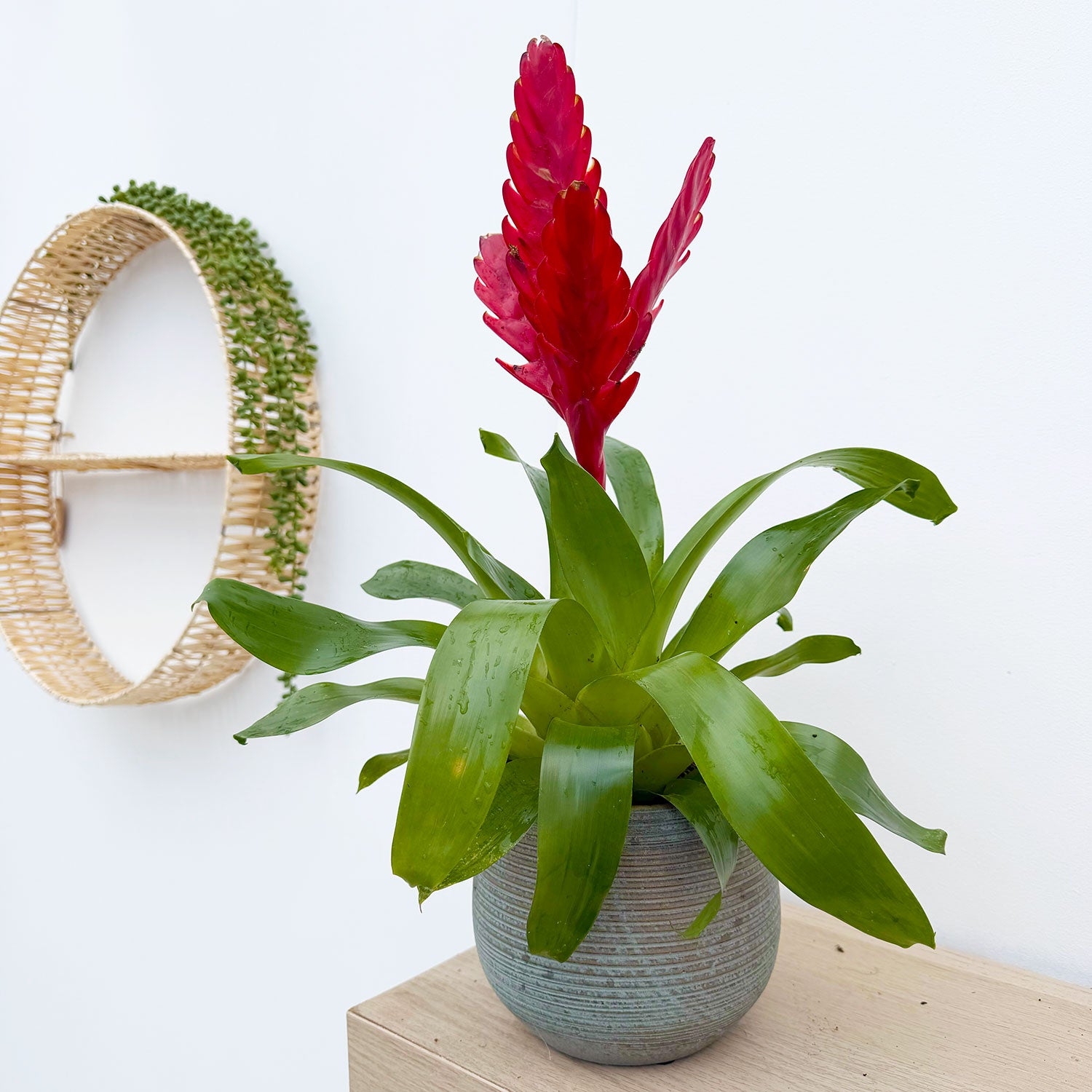
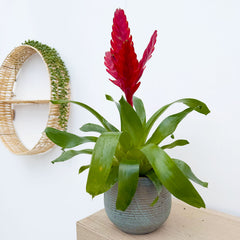
Vriesea ‘Flaming Sword’ is a spectacular tropical bromeliad best known for its dramatic, brightly coloured flower spike rising above a neat rosette of glossy green foliage. Its combination of architectural leaves and long-lasting colour makes it an excellent statement houseplant, even where space is limited.
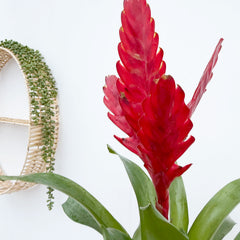
The plant forms a broad funnel-shaped rosette of smooth, strap-like green leaves. From the centre of a mature plant emerges its characteristic flattened flower spike, which resembles an upright sword and gives the plant its memorable common name.
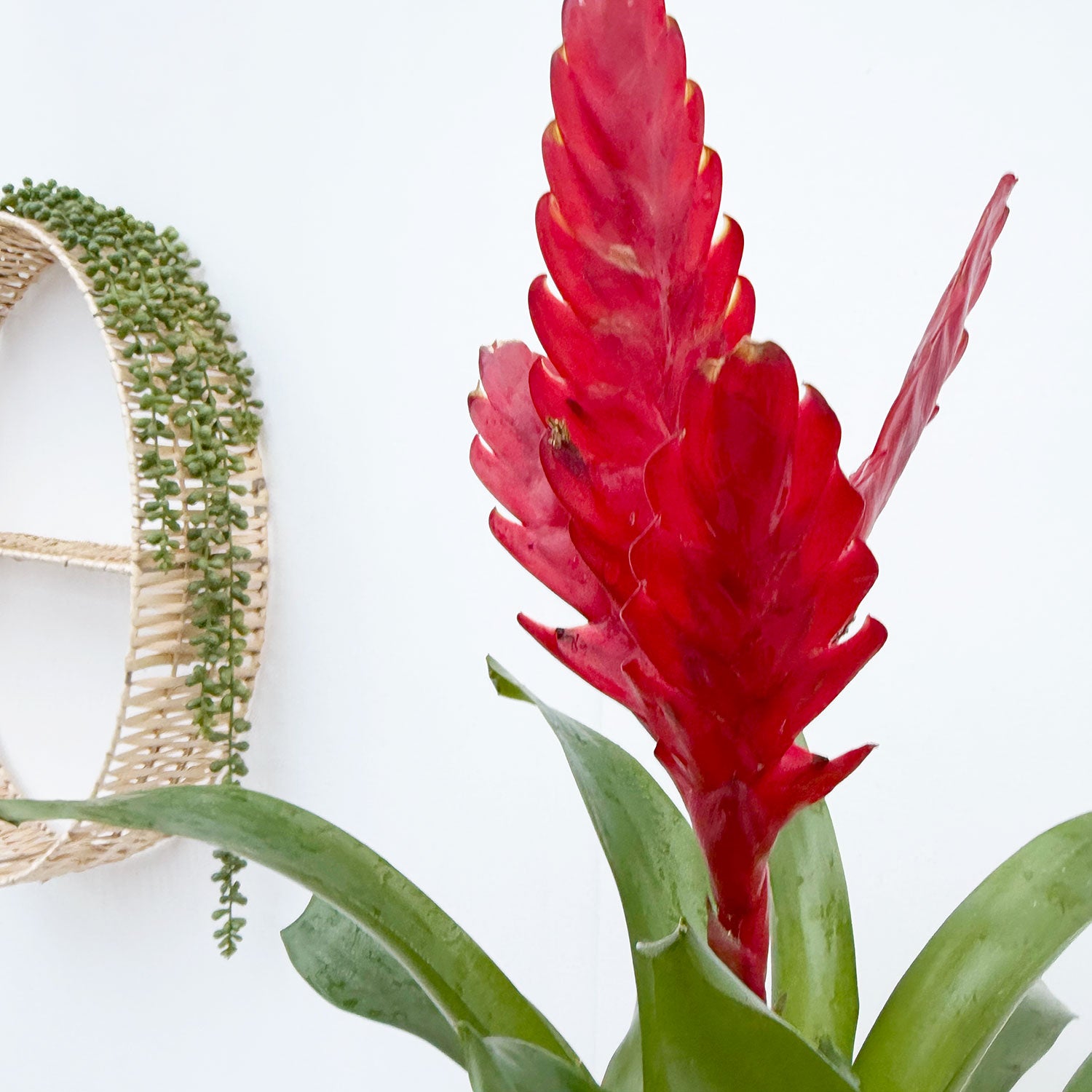
The colourful part commonly thought of as the flower is actually made up primarily of brightly coloured bracts. The true flowers are smaller and emerge from between these bracts. While individual flowers are relatively short-lived, the colourful bracts can remain attractive for a considerable period, giving Vriesea Flaming Sword a much longer display than many conventional flowering houseplants.
Vriesea are epiphytic bromeliads. In their natural tropical environment, they can grow attached to trees rather than rooted deeply into the ground. Their roots are therefore used substantially for anchorage, while the central rosette is adapted to collect moisture and nutrients.
One important characteristic of Flaming Sword is its lifecycle. Each mature rosette flowers only once. After flowering, the original plant gradually begins to decline, but this is completely natural. Before dying back, a healthy plant normally produces new offsets, commonly called pups, around its base.
These pups can eventually develop into mature plants of their own, allowing the lifecycle to continue.
Vriesea Flaming Sword prefers bright, indirect or filtered light.
In its natural habitat, Vriesea often grows beneath the canopy of larger trees, where it receives good light without prolonged exposure to intense sunshine.
An east- or west-facing window can work particularly well. It can also be positioned slightly further back from a bright south-facing window.
Some gentle morning or evening sunlight is normally tolerated.
Avoid prolonged exposure to intense midday or afternoon sunshine, which can scorch the foliage and may cause the colourful bracts to fade more quickly.
Plants kept in very low light may survive but can become slower growing and may struggle to produce strong future growth.
Ideal: Bright, indirect or filtered light.
Watering a Vriesea is slightly different from watering many conventional houseplants because bromeliads are adapted to collect moisture within their central rosette.
The centre of the plant forms a natural cup or tank where water can collect.
During active growth, a small amount of fresh water can be maintained within this central cup.
However, it is important that the water does not become permanently stagnant.
Regularly empty and refresh the water within the rosette, particularly during warm weather. This helps prevent unpleasant smells, bacterial growth and rot.
The compost itself should be kept lightly moist but never saturated.
Allow the upper portion of the growing medium to begin drying before watering the compost again.
During autumn and winter, reduce watering and avoid leaving large quantities of cold water sitting within the centre of the plant for extended periods.
The roots of epiphytic bromeliads are particularly vulnerable to rot when kept permanently wet.
Vriesea can be sensitive to excessive minerals and chemicals within tap water.
Where possible, use:
This is particularly beneficial when adding water directly to the central rosette.
Hard water can leave visible mineral deposits on the foliage and within the plant's central cup.
If using tap water, allowing it to reach room temperature before watering can help prevent temperature shock.
Vriesea Flaming Sword appreciates moderate to high humidity.
Ideally, aim for humidity of approximately 50–70% or above.
This makes the plant particularly suitable for:
It can adapt to average household humidity, but prolonged exposure to extremely dry air may cause brown or crispy leaf tips.
Central heating can significantly reduce humidity during winter, so avoid positioning the plant directly beside radiators or heaters.
Good airflow is also important.
High humidity combined with stagnant air and excessive moisture around the crown can encourage fungal and bacterial problems.
Vriesea Flaming Sword prefers warm, stable conditions.
An ideal temperature range is approximately 18–27°C.
Avoid prolonged temperatures below approximately 15°C.
The combination of cold temperatures and excessive moisture can be particularly damaging to bromeliads.
Protect the plant from:
Normal warm household temperatures are generally ideal.
Vriesea Flaming Sword requires a light, open and extremely well-draining growing medium.
As an epiphytic bromeliad, its roots are not naturally adapted to sitting within dense, permanently wet compost.
A suitable mixture can contain:
A specialist bromeliad or orchid-based growing medium can also work well.
The important thing is to provide excellent drainage and plenty of airflow around the roots.
Avoid heavy, compacted compost.
Vriesea has relatively modest feeding requirements.
During spring and summer, apply a very diluted balanced liquid fertiliser approximately once every 4–6 weeks.
Avoid excessive feeding.
Bromeliads can be sensitive to high concentrations of fertiliser and the resulting mineral salts.
If applying fertiliser to the growing medium, ensure it is heavily diluted.
Feeding should normally be reduced significantly or stopped during autumn and winter.
The dramatic sword-shaped structure is the defining feature of Vriesea Flaming Sword.
The brightly coloured sections are bracts rather than the true flowers.
Small flowers emerge from between these bracts during the blooming period.
Although the individual flowers don't last particularly long, the colourful bracts can remain attractive for several months under favourable conditions.
To help maintain the display:
Eventually, the flower spike will begin to fade and turn brown.
This is a normal part of the plant's lifecycle.
Once the flower spike has completely faded and become brown, it can be removed.
Using clean, sharp scissors or secateurs, cut the old flower stalk as close to its base as reasonably possible without damaging the surrounding foliage.
The original rosette will not produce another flower spike.
Instead, it will gradually begin directing its energy towards producing pups around its base.
The parent plant may remain attractive for many months after flowering before gradually declining.
Do not discard the plant immediately after the flower fades.
Vriesea Flaming Sword follows the typical bromeliad lifecycle.
A mature rosette grows, flowers once and then gradually declines.
Before the parent plant dies, it normally produces one or more pups or offsets from around its base.
These are genetically identical young plants that can eventually replace the original rosette.
Initially, leave the pups attached to the parent plant.
They benefit from remaining connected while establishing their own roots and foliage.
For the strongest results, wait until a pup reaches approximately one-third to one-half the size of the parent plant before considering separation.
Alternatively, the pups can be left attached to create a larger cluster of bromeliads.
Once a pup is sufficiently established, carefully remove the plant from its pot and inspect where the offset connects to the parent.
Using a clean, sharp knife, separate the pup while retaining as many of its own roots as possible.
Pot the young plant into a small container containing a light, free-draining bromeliad mixture.
Keep the newly separated plant:
Avoid using an excessively large pot.
Young bromeliads have relatively small root systems and are particularly vulnerable to overwatering when surrounded by too much wet compost.
Vriesea Flaming Sword does not require frequent repotting.
Its root system is relatively small compared with the size of the foliage because the roots primarily provide anchorage.
Repotting may be required when:
A relatively small pot is generally preferable.
When repotting, avoid burying the central crown too deeply, as this can encourage rot.
Very little pruning is required.
Remove:
Individual brown leaf tips can be carefully trimmed for cosmetic purposes.
Follow the natural shape of the leaf when cutting.
Avoid damaging the central growing point of young, non-flowering rosettes.
Brown or crispy tips can be caused by:
If the rest of the plant remains healthy, minor brown tips are usually cosmetic.
Switching to rainwater or filtered water can help if the problem occurs repeatedly.
Yellowing foliage can result from:
Remember that a parent rosette will naturally begin to deteriorate after flowering.
If an older flowering plant slowly yellows while healthy pups are developing around the base, this is usually part of its normal lifecycle rather than a care problem.
The flower spike naturally turns brown at the end of its display.
Once completely faded, cut it away near the base.
This does not mean the entire plant has suddenly died.
Continue caring for the foliage and look for developing pups around the base.
A soft, dark or unpleasant-smelling central rosette can indicate crown rot.
Possible causes include:
Regularly refreshing the water within the central cup and reducing watering during cooler conditions can help prevent this.
Root rot is generally associated with dense compost and excessive watering.
Healthy bromeliad roots should not remain surrounded by permanently saturated growing medium.
If rot is suspected, remove the plant from its pot, cut away badly damaged roots and repot into fresh, airy bromeliad compost.
Pale foliage can be associated with:
If the plant is exposed to strong direct sunshine, move it somewhere with more filtered light.
Pups generally appear around or after flowering, but they may not develop immediately.
Continue providing suitable care after the flower fades.
Warm temperatures, good indirect light and appropriate watering will help support offset development.
Vriesea Flaming Sword can occasionally be affected by common houseplant pests, particularly:
Regularly inspect:
Mealybugs can hide particularly effectively between tightly overlapping leaves.
If pests are discovered, isolate the plant while treatment is carried out.
Vriesea Flaming Sword is generally considered an easy to moderately easy houseplant.
Its care differs slightly from conventional foliage plants because of its epiphytic growth habit and water-holding central rosette.
The most important things to remember are:
Understanding its natural lifecycle is particularly important.
The original rosette dying after flowering is normal rather than a sign of failure. Healthy pups produced around the base are the next generation of the plant.
Vriesea Flaming Sword makes an excellent colourful feature plant.
Suitable positions include:
Its combination of a compact footprint and tall flower spike makes it particularly useful for adding height and colour without requiring a large amount of space.
Common Name: Flaming Sword
Plant Type: Epiphytic bromeliad
Light: Bright, indirect or filtered light
Water: Keep the growing medium lightly moist; refresh water in the central rosette regularly
Humidity: Moderate to high; approximately 50–70% or above
Temperature: Ideally 18–27°C
Soil: Very airy, free-draining bromeliad or orchid-style mix
Feeding: Very diluted fertiliser approximately every 4–6 weeks during spring and summer
Repotting: Infrequently; bromeliads have relatively small root systems
Growth Habit: Upright, rosette-forming
Flowering: Each mature rosette flowers once
Propagation: Pups or offsets produced around the base
After Flowering: Parent rosette gradually declines while producing new plants
Difficulty: Easy to moderate
Overall rating: 5.0 / 5 from 5 reviews.
Review topics: [].
"A beautiful plant, makes me happy! Another gem from Plants for all."
"Plant came in lovely condition and was delivered quickly."
"Very healthy plant and as per description, loved it"
"The plants were in very good condition and the packaging was great."
"Lovely healthy plant, packaged very well, will definitely be ordering again"
ONLY
30
LEFT
🌱 FREE WITH ORDERS OVER £50

By Plants for all Seasons
A plant care expert that gives clear, friendly advice for all your houseplants and garden plants – tailored to UK conditions. Perfect for beginners and seasoned growers alike.
Terms of Use