






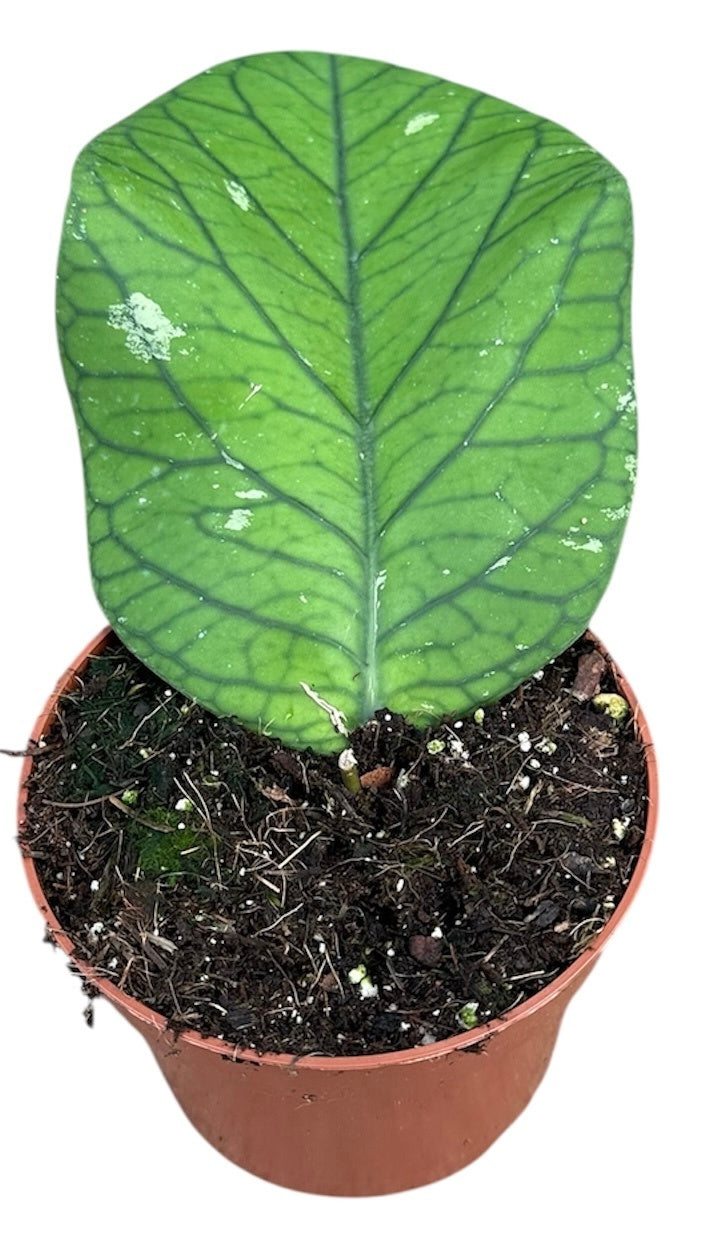
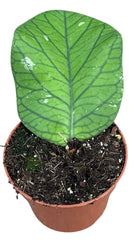





Hoya meredithii ‘Ted Green’ is a highly sought-after and striking Hoya cultivar known for its large, thick leaves with dramatic veining. Native to the tropical forests of Southeast Asia, Hoya meredithii grows naturally as an epiphytic climber, attaching itself to trees where it receives bright filtered light and high humidity.
The ‘Ted Green’ form is particularly admired for its bold foliage, featuring broad, oval leaves with prominent dark green veins running across a lighter green background. The leaves are thick, slightly textured, and can become impressively large when the plant is grown in bright conditions and allowed to climb.
As the plant matures it produces long climbing vines, which can be trained around a trellis or hoop. Mature specimens may eventually reward growers with clusters of waxy star-shaped flowers, often cream to yellow with a reddish centre and a noticeable sweet fragrance.
Because of its dramatic foliage and relatively slow but rewarding growth, Hoya meredithii ‘Ted Green’ is especially prized among Hoya collectors and rare plant enthusiasts.
Key Features
-
Leaf colour: Bright to mid green with bold dark green veins
-
Leaf shape: Broad, oval leaves
-
Leaf texture: Thick, slightly textured foliage
-
Growth habit: Climbing or trailing vine
-
Growth rate: Slow to moderate
-
Mature leaf size: Leaves can reach 15–25 cm long under ideal conditions
-
Mature vine length: Up to 1–2 metres indoors
Hoya meredithii ‘Ted Green’ Care Guide
Light
Hoya meredithii thrives in bright, indirect light.
Ideal placement:
-
Near east or west-facing windows
-
Bright rooms with filtered sunlight
Good light helps develop larger leaves and stronger vein contrast. Avoid intense direct afternoon sun, which can scorch the foliage.
Watering
Allow the soil to dry partially between waterings.
Typical schedule:
-
Spring & summer: Every 7–10 days
-
Autumn & winter: Every 2–3 weeks
Because the leaves store moisture, Hoyas prefer slightly drier soil rather than constantly wet conditions.
Always ensure the pot has excellent drainage.
Humidity
Hoya meredithii benefits from moderate to high humidity.
Ideal humidity range:
-
60–80%
Higher humidity can help encourage larger foliage and healthier growth, although the plant can adapt to typical indoor conditions.
Temperature
Best grown in temperatures between:
18°C – 28°C
Avoid:
-
Temperatures below 12°C
-
Cold drafts or sudden temperature changes
Warm, stable conditions are ideal.
Soil
Use a very airy epiphytic soil mix.
A suitable mix may include:
-
Orchid bark
-
Perlite or pumice
-
Coco coir or houseplant compost
This type of mix keeps roots well oxygenated and prevents waterlogging.
Feeding
Feed lightly during the growing season.
-
Spring & summer: Every 3–4 weeks
-
Use a balanced liquid houseplant fertiliser
Reduce feeding during winter.
Growth Support
Hoya meredithii grows best with climbing support.
You can grow it:
-
On a trellis or hoop
-
Along a moss pole
Climbing encourages larger leaves and stronger growth.
Flowering
Mature plants may produce clusters of fragrant waxy flowers.
Tips to encourage blooms:
-
Provide bright light
-
Keep the plant slightly root-bound
-
Do not remove peduncles (flower spurs) after flowering, as Hoyas bloom repeatedly from them.
Propagation
Hoya meredithii can be propagated through stem cuttings.
Steps:
-
Take a cutting with one or two nodes
-
Root in water, sphagnum moss, or airy soil
-
Place in warm, bright indirect light
Roots usually develop within 2–4 weeks.
Toxicity
Hoyas are generally considered non-toxic to pets, though ingestion may still cause mild digestive upset.
Common Problems
Yellow leaves
-
Often caused by overwatering
Wrinkled leaves
-
Indicates the plant may need watering
Slow growth
-
Often due to low light or cool temperatures
Lack of flowering
-
Usually caused by insufficient light or an immature plant
✅ Summary
Hoya meredithii ‘Ted Green’ is a spectacular climbing wax plant prized for its large veined leaves and dramatic tropical appearance. With bright indirect light, airy soil, and moderate watering, it develops into a striking plant that can eventually produce clusters of fragrant waxy flowers, making it a rewarding addition to any Hoya or rare houseplant collection.
